Capitec Credit Facility Costing You R2,400/Year? 2026 Fee Analysis
Capitec's credit facility can cost R2,400/year in interest charges. Learn how to spot hidden fees, avoid insurance you don't need, and optimize your banking costs. 2026 fee breakdown & statement guide.
Disclaimer: This analysis is based on publicly available information as of 28 January 2026. Banking fees, interest rates, and inflation figures can change; always verify current rates with Capitec directly or consult official sources. The opinions expressed are those of the author and do not constitute financial advice.
Capitec is South Africa's people's bank. With over 22 million clients and a reputation for simplicity, it's become the default choice for cost-conscious South Africans who want straightforward banking without the complexity of traditional banks. The marketing message is clear: simple, affordable, transparent.
To Capitec's credit, the bank has genuinely simplified its fee structure in recent years, consolidating transaction costs into five key price points (R1, R2, R3, R6, R10). But simple doesn't mean free. And affordable doesn't mean there aren't costs that add up on your Capitec statement.
While Capitec's base account fee is genuinely low, the bank generates revenue from sources that many customers don't actively track — credit facility interest, insurance product cross-selling, and transaction fees that chip away at your balance month after month. This guide unpacks exactly what's happening on your Capitec bank statement.
The Global One Account: Simple on the Surface
Capitec's Global One account is an all-in-one product that combines three facilities:
- Transaction facility — Your everyday spending account
- Savings facility — Savings pockets with interest
- Credit facility — A pre-approved credit line linked to your account
The monthly administration fee is R7.50 (effective from 1 October 2025), which remains one of the lowest in South Africa. You'll need to maintain a minimum balance of R30 to avoid additional charges.
For comparison, FNB Bank Fees 2026: Are You Overpaying R1,200/Year?(FNB Aspire) costs R120/month (with unlimited electronic transactions included), while Standard Bank Fees 2026: When UCount Rewards Don't Cover Costs(Standard Bank MyMo) is also competitively priced at R7.50/month. Capitec remains among the most affordable options, though competitors have introduced similarly priced entry-level accounts.
Transaction Fees: Simplified but Still Present
Capitec simplified its fee structure in 2025/2026 to five key price points, making it easier to understand what you'll pay:
| Transaction Type | Fee |
|---|---|
| Internal transfer | R0 (free between own accounts) |
| Card purchase (in-store) | R0 (free) |
| Debit order | R3 |
| Payment to other banks | R2 |
| Immediate payment to other banks | R6 |
| Cash withdrawal (any SA ATM) | R10 per R1,000 |
| Cash deposit (notes via cash-accepting ATM) | R1.40 per R100 |
This simplification is a positive development — you can now predict costs more easily. However, for someone making 25–30 transactions per month (a typical pattern), transaction fees can still add R50–R100 to the base R7.50. That R7.50 account may cost R60–R110 per month in total banking fees, which is still competitive but worth tracking.
Capitec's Credit Facility: A Key Risk to Monitor
This is where Capitec statements tell a story that many customers don't want to hear. The credit facility can be a significant cost for those who use it regularly.
How It Works
Capitec pre-approves credit facilities for many customers based on income and transaction patterns. You might find R5,000, R10,000, or even R30,000+ of credit available on your account without having specifically applied for it.
The credit facility is linked directly to your transaction account. When your transaction balance runs low, the credit facility can seamlessly cover the gap. There's no separate approval step, no additional login, no friction. Your card simply works — funded by credit you're now paying interest on.
The Interest Rate Reality
Capitec's credit facility charges interest between 12.25% and 20.75% per year on the outstanding balance, depending on your credit profile. Customers with better credit histories qualify for rates at the lower end of this range.
To put that in perspective (using the maximum 20.75% rate):
- R5,000 on credit for one month: ~R86 in interest
- R10,000 on credit for three months: ~R518 in interest
- R15,000 on credit for six months: ~R1,556 in interest
At the lower 12.25% rate, these figures would be approximately 40% less. Check your personal rate in the Capitec app or by contacting the bank.
These charges appear on your statement as interest line items, but many customers don't connect them to the credit facility usage. They just see their balance shrinking.
A Real-World Scenario
Consider Thandi, who earns R18,000 per month. Her expenses consume her full salary by the 20th of each month. For the last 10 days, she dips into her R8,000 credit facility for groceries and petrol — about R3,000 per month.
She pays it back on payday, but then the cycle repeats. Every month (assuming a mid-range 16% rate):
- Credit used: R3,000 for ~10 days
- Monthly interest cost: ~R13
- Annual cost of this pattern: ~R160 in interest alone
That doesn't sound catastrophic. But Thandi doesn't realise the interest is compounding, and months where unexpected expenses push her further into the facility — car repairs, medical bills — can spike her interest significantly. Over time, the facility balance can creep higher.
Managing the Credit Facility
A key risk of Capitec's credit facility is the lack of friction. Because there's no separate approval step, many customers don't realise they've crossed from their own money into borrowed money. The balance on their account looks positive (it includes the available credit), masking the fact that they're spending on debt.
Tip: You can request to have your credit facility removed or reduced by contacting Capitec. This is worth considering if you find yourself dipping into it regularly. Opting out entirely removes the temptation and ensures you only spend what you have. If debt is a concern, check out our Debt Payoff Calculator to see your payoff timeline.
Funeral Plan & Insurance Deductions: Worth Reviewing
Capitec offers various insurance products to its customer base, including:
- Funeral cover — Starting from R25/month (for up to R100,000 cover), with premiums varying by cover level and number of members
- Credit life insurance — May be required if you have a credit facility above certain limits
- Device insurance — For phones and other electronics purchased through Capitec
- Legal insurance — Added protection packages
A positive aspect of Capitec's funeral cover is that there are no automatic annual premium increases, providing cost predictability.
How They Can Accumulate
The issue isn't necessarily one insurance product — it's the accumulation if you've signed up for multiple products:
| Product | Example Monthly Cost |
|---|---|
| Funeral cover (individual) | From R25 |
| Funeral cover (family extension) | From R60 |
| Credit life insurance | ~R50–R80 |
| Device insurance | ~R49 |
| Potential Total | R180–R250+ |
Note: These are example figures only. Actual premiums depend on factors such as age, cover amount, and individual profile.
Suddenly, a customer paying R7.50 in account fees might be paying significantly more to Capitec across all products. And because each deduction is relatively small and automatic, it doesn't trigger the same scrutiny as a single large payment would.
What to Look For on Your Statement
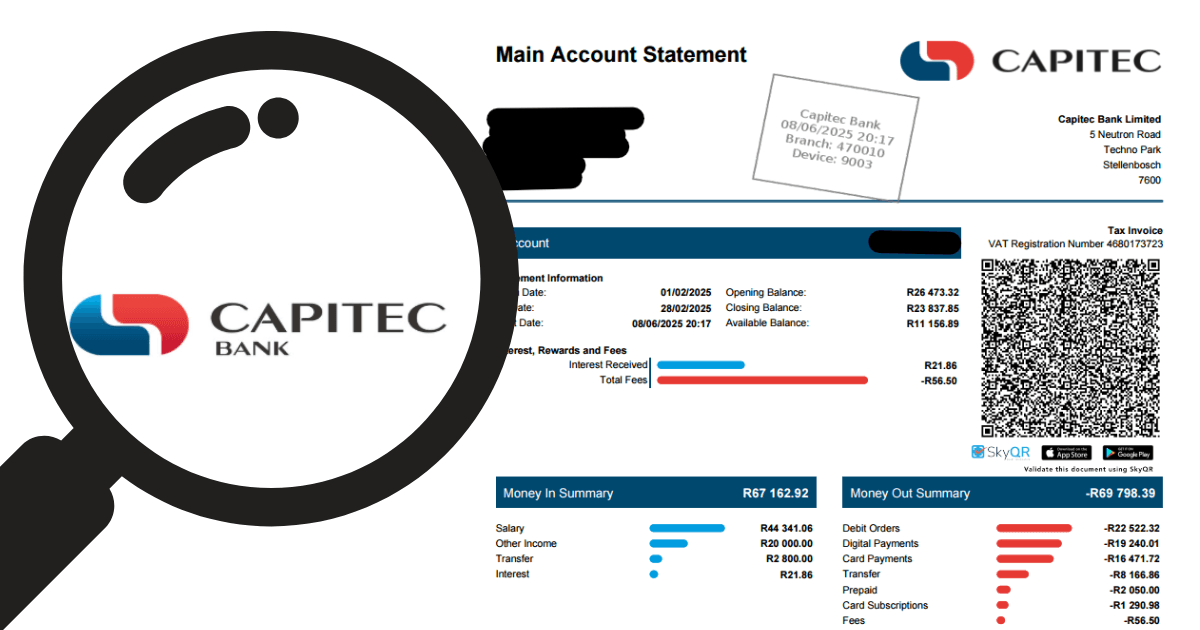
On a Capitec statement, insurance deductions typically appear as separate line items with descriptions like "CAPITEC FUNERAL" or "CREDIT LIFE INS" or similar abbreviations. Review three months of statements and list every recurring deduction that goes to a Capitec product. You may find products you'd forgotten about.
Savings Pocket Reality Check
Capitec's savings pockets are one of the bank's most marketed features. The idea is sound — separate your savings from your spending money to avoid accidentally spending what you're trying to save.
Interest Rates vs Inflation
Capitec offers tiered interest on savings pockets, with rates that vary by access type and term:
| Savings Type | Interest Rate Range |
|---|---|
| Instant access | 2%–5.75% |
| Notice deposit (32 days) | 4%–7.15% |
| Fixed-term deposit | Up to 8.30% (higher rates for longer terms and larger deposits) |
Rates as of January 2026. Higher rates within ranges typically require larger balances or longer lock-in periods.
South African inflation context:
- 2025 average: 3.2% (the lowest in 21 years)
- December 2025: 3.6%
- 2026 projection: approximately 3.2%–3.6%
Real returns:
- Instant access at 5.75% vs 3.2% inflation = ~2.55% real return
- Fixed-term at 8.30% vs 3.2% inflation = ~5.1% real return
This is better than in previous years when inflation was higher. Your savings can genuinely grow in purchasing power, particularly with fixed-term options.
Access Fees and Lock-In
Fixed-term savings pockets offer better rates but lock your money for a set period (30 days to 60 months). Accessing funds early may result in reduced interest or penalty fees. The highest rates (around 8.30%+) typically require larger deposits (R1 million+) and longer terms.
The Real Role of Savings Pockets
Savings pockets are genuinely useful as a budgeting tool — separating rent money, grocery money, and emergency funds so you don't accidentally spend them. For emergency savings you might need to access quickly, the instant access pockets are appropriate despite lower rates. For longer-term goals, fixed-term options now offer rates that meaningfully beat inflation.
What MyFinHealth Finds on Capitec Statements
When you upload your Capitec bank statement to MyFinHealth, our analysis identifies Capitec-specific patterns that you might otherwise miss.
Credit Facility Interest Detection
MyFinHealth automatically spots credit facility interest charges on your statement and calculates your total interest paid over the statement period. We flag months where credit usage spiked and show you the cumulative cost of relying on the facility.
Insurance Deduction Audit
We identify all recurring deductions going to Capitec insurance products — funeral cover, credit life, device insurance, and others. MyFinHealth totals these deductions and shows you the combined monthly cost, making it easy to decide which products you actually need.
Real Savings Rate Calculation
MyFinHealth calculates the actual interest you're earning on savings pockets and compares it against current inflation. You'll see whether your savings are genuinely growing in purchasing power.
Spending Pattern Analysis
Beyond fees, MyFinHealth categorises all your Capitec transactions to reveal where your money actually goes. This includes identifying recurring subscriptions, spending spikes, and patterns that explain why you might be dipping into the credit facility each month.
Frequently Asked Questions
How much does a Capitec Global One account cost per month?
The base monthly administration fee is R7.50 (as of October 2025). However, the true cost of banking with Capitec includes transaction fees (R3 per debit order, R10 per R1,000 cash withdrawal, etc.), credit facility interest if used, and any optional insurance products. A typical Capitec customer's total monthly banking cost varies widely based on usage — from under R50 for minimal transaction users to R150+ for those with multiple products and regular cash transactions.
What is the interest rate on Capitec's credit facility?
Between 12.25% and 20.75% per year on the outstanding balance, depending on your credit profile. Customers with better credit histories qualify for lower rates. Check your personal rate in the Capitec app.
Does Capitec automatically give you a credit facility?
Capitec pre-approves credit facilities for many customers based on income and account history. You may have a credit limit available without having applied for one. You can request to have it removed or reduced by contacting Capitec, or opt out entirely — worth doing if you find yourself dipping into it regularly.
Are Capitec savings pockets worth it?
For budgeting and separating funds, yes. For returns, Capitec now offers competitive rates: instant access up to 5.75%, notice deposits up to 7.15%, and fixed-term up to 8.30%. With 2025/2026 inflation around 3.2%–3.6%, these rates can provide meaningful real returns, especially for fixed-term savings. However, fixed-term options require you to lock funds away, with penalties for early access.
Can MyFinHealth analyse a Capitec bank statement?
Yes. Upload your Capitec statement PDF to MyFinHealth and we'll identify credit facility interest charges, flag all insurance deductions, calculate your real savings rate versus inflation, and categorise every transaction to show you exactly where your money goes each month.
Understand Your True Banking Costs
Capitec's simplicity and low base fees are genuine advantages. The bank has made positive changes like simplifying its fee structure and keeping funeral cover premiums stable. However, credit facility interest and accumulated insurance deductions can still add up — understanding these costs helps you make informed decisions.
Breaking free from high-interest credit facility debt? Check how much those monthly savings boost your bond affordability with our Bond Affordability Calculator(free calculator).
Upload your Capitec bank statement to MyFinHealth Pricing and see the full picture. Our analysis takes minutes and reveals costs that your banking app doesn't highlight.
Last updated: 28 January 2026. Fees and rates change periodically — always verify current information with Capitec directly.
Written by
Steven
Founder, MyFinHealth